Many people credit good friends or religion with helping them survive rough times. For Aric Nelson, it was the circus.
Growing up in San Bernardino, California, Nelson found himself surrounded by gang members and drug dealers. He did not want that life. Circus work gave him another direction, and over time it became more than a talent. It became a structure for living.
“I had good parents, but the circus is what gave me the direction to stay off of the streets,” Nelson said. “So it’s my responsibility, but more of my pleasure, to try and provide people with the same thing it gave to me.”
That conviction became Stasia Acrobatics, an amateur acrobatic troupe Nelson founded in 2012 to introduce a new generation to the discipline, beauty, and rigor of circus performance.
Today, the troupe has performed in more than 280 shows. Its members come from all kinds of backgrounds and stages of life. Some are elementary school students. Others are in college or well into adult responsibilities. The team has included a plumber, a software engineer, a barista supervisor, a technician, a caregiver, a mother, and a former Marine. Ages have ranged from seven to twenty-seven.
More Than Spectacle
The work itself carries all the visual thrill people expect from circus acrobatics. Stasia performers build three-person-high pyramids, spin on a lyra above the floor, and execute routines that demand precision from every body involved. The danger is real, but Nelson insists that the spectacle is never allowed to outrun the fundamentals.
As the self-described “father” of the troupe, he treats safety as a moral responsibility. Only a small number of members perform at events, and each one has to earn that place. Students are expected to build strength, flexibility, and trust long before they are asked to attempt the more dangerous stunts.
“We take our time to develop skills,” Nelson said. “Basics are extremely important to everything we do in life, but especially here. Bad basics breed injuries. So we work to make sure their basics are solid.”
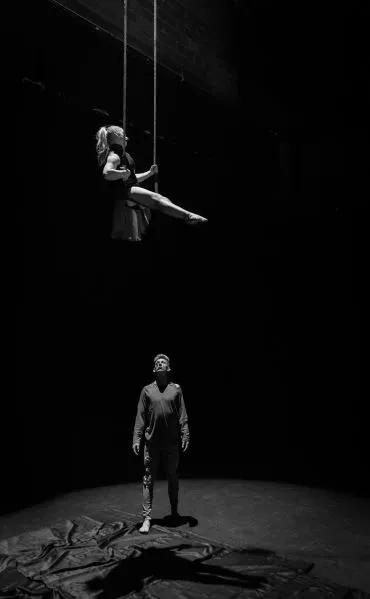
Nelson has spent eighteen years in the circus world, and experience has only made him more committed to repetition. No matter how advanced a student becomes, he brings them back to the basics.
Discipline as a Way of Life
Nelson demands a great deal from the troupe, jokingly calling himself “the mean dad.” Team members must maintain at least a 2.7 GPA to stay in the program. Phones go into a wooden box at practice so attention stays on the work. Parents text Nelson directly if they need to reach their children.
The point is not control for its own sake. Nelson wants his students to learn a form of discipline that can outlast any single performance.
“Discipline is not the enemy of enthusiasm, it’s just giving you the tools to focus and be better at what you’re trying to accomplish,” he said. “You have to have that discipline to be successful.”
At the troupe’s practice facility in Ammon, members are expected to work together without being constantly managed. Nelson wants them to become self-directed, able to solve problems and carry responsibility without leaning on somebody else to narrate every next step.
“I don’t want to hold their hand,” Nelson said. “The one thing we want them to do is to be able to think on their feet and outside the box. I don’t want them to be an echo of me.”
That independence extends beyond the routines themselves. The performers even designed and made their own costumes for the year, another way of learning that excellence is built through ownership as much as instruction.
A Different Future
Like their mentor, many Stasia performers have found in acrobatics more than a hobby. Nelson says some students have come from difficult backgrounds, and the structure of the troupe has helped them become steadier students, workers, and people. Those in school have improved their grades, many earning A’s and B’s. Those with jobs have impressed employers.
At one point, Nelson met the supervisor of one of his students. The boss had a simple question for him: “You got more?”
“My goal is to make them successful not just here, but in life,” Nelson said. “You see a bunch of them have gone through some hard times. Some have really rough backgrounds, and this has helped them. It did for me.”
For Alex Johnston, who joined the team when it began and had already performed in more than 200 shows by age eleven, the dream is straightforward. She wants to become a professional like Nelson.
Johnston joined the team back when it started seven years ago.
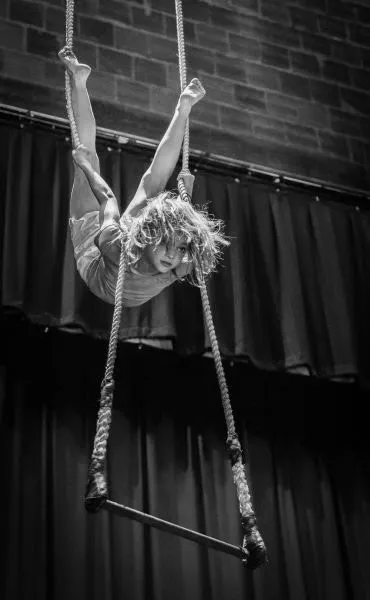
“This is like my dream,” Johnston said. “Aric is helping us get to our dreams.”
Even members who came to the troupe later in life describe the work with an intensity that goes far beyond casual recreation. Aly Rhead, a retail manager who has been part of Stasia for seven years, said the commitment has shaped much of her adult life.
“People think of a hobby as, ‘I paint when I go home,’” Rhead said. “But this is almost like a second or third job for me. I take it pretty serious to where it’s more like a passion. I show up four days a week, sometimes more if we have shows. It’s almost like an obsession.”
That may be the clearest way to understand what Nelson has built. Stasia Acrobatics is not simply a place to learn tricks. It is a place where effort becomes trust, repetition becomes confidence, and form becomes a means of making a life more disciplined, more hopeful, and more free.